He everybody! Here is an interesting piece from Mat Lalonde. if y’all do not know, Mat and Bobbi are the new East Coast CrossFit Nutrition Certification Crew. They kick ass! I’m working on the back-end of the site (actually, Craig is!) to make it easy for Mat and Bobbi to add content and comment on things. We will have much more action on the site, Bobbi will have some great insights on how and when to use the Zone. It will be good!
Here is Mat’s Low Carb experiment:
CrossFit on a Low-Carb Paleo Diet
Every now and then, an excellent piece of scientific research comes along and forces many of us to reevaluate our positions or question what we thought we knew. This happened to me last May when a paper entitled “Antioxidants Prevent Health-Promoting Effects of Physical Exercise in Humans” was published in the Proceedings of the National Academy of Sciences. The following conclusion can be found in the abstract of the paper:
“Consistent with the concept of mitohormesis, exercise-induced oxidative stress ameliorates insulin resistance and causes an adaptive response promoting endogenous antioxidant defense capacity. Supplementation with antioxidants may preclude these health-promoting effects of exercise in humans”.
Essentially, the antioxidants are quenching the reactive oxygen species (ROS), which prevents oxidative damage and blunts the expression of ROS-sensitive transcriptional regulators of insulin sensitivity. This means that ingesting large quantities of antioxidants prevents you from improving your insulin sensitivity, which is a major benefit of exercise (another study on ROS and insulin sensitivity was published during the writing of this blog post).
I was somewhat taken aback to find out that a daily intake of 1.0 gram of vitamin C and 400 IU of vitamin E could negate the insulin sensitivity gained through exercise. I wasn’t taking any vitamin supplements at the time because of research indicating that multivitamins are essentially useless, maybe even harmful. Nevertheless, this whole thing really got me thinking about insulin sensitivity and brought back memories of this interesting post I had read on Arthur De Vany’s blog. The research discussed in the post demonstrates that insulin sensitivity is not improved when a PWO meal of carbohydrate is employed to replenish glycogen stores. Hmmm…that sounds a lot like the vitamin C/E paper doesn’t it? Some more research on the subject of post-workout carbs led me to this excellent post by Mark Sisson, which was followed by this equally interesting post. At this point, a lot research seemed to indicate that PWO carbohydrates were not necessary, maybe even detrimental, and that a PWO meal of protein, although desirable, was also not absolutely required. Within 24 hours, Glycogen stores should be sufficiently replenished for another workout thanks to gluconeogenesis (new creation of glucose) from dietary protein and lactate as long as the levels of dietary protein (for muscle repair and glucose synthesis) and fat (for fuel) are adequate. However, gluconeogenesis takes place in the liver and only a fraction of the glucose makes its way to the muscles. This means it would probably be wise to consume some carbohydrate from vegetables to help replenish muscle glycogen. Vegetables are preferable given that they don’t contain the toxin fructose and they come packed with vitamins, antioxidants and a variety of phytochemicals.
After having read all this research, I was now determined more than ever to try CrossFit on a low-carb Paleo diet. Most people would tell you this is a bad idea. After all, it is well known that free fatty acids and glucose (from liver and muscle glycogen) feed your working muscles while you train. As it turns out, glucose is especially needed during high intensity exercise because it requires less oxygen to burn than free fatty acids. The increase in glucose as fuel makes sense because, let’s face it, we need all the oxygen we can get during “Fran”. So was I worried about CrossFitting on a low-carb paleo diet? Not really. Most CF WODs are short, and not all of them are heavily dependant on glycogen. Gluconeogenesis and carbohydrate from veggies should be sufficient to hold up my glycogen stores to a reasonable level once my body adapted to my new diet. Additionally, a potential increase in intramuscular triglycerides could help me through intense bouts of exercise in the event that my glycogen stores get too low.
The decision was made. I was going to follow the CrossFit main site WODs without any pre- or post-workout meal while on a diet that provided just a little over 50 grams of useable carbohydrate per day (mainly from vegetables). The research on fat adaptation mentioned in one of Robb’s posts told me this wasn’t going to be easy. I figured it would take at least two months to get used to my new diet since enzymes involved in gluconeogenesis and fat burning would have to be upregulated while enzymes for burning sugar would be downregulated. I wasn’t sure this was going to work but I knew the worst thing that would happen was that I wouldn’t set any new PRs for a while. I was pretty sure nothing bad would happen given that the explorers V. Stefansson and K. Andersen survived on a diet of meat and animal fat for one year and came out healthier for it.
Most of the protein I consumed during this experiment came from my Chestnut Farms CSA, which provides 20 pounds of meat from grass-fed or pastured animals every month. The shares include a variety of cuts of pork, lamb, beef, and chicken. I also buy the occasional goat meat and make sure to get the super nutritious organ meats (beef liver and heart) that Chestnut Farms sells on site. Given that the protein side of things was taken care of, I hit stores in my area to purchase a variety of high fat foods. I ended up with the following list:
- François Pralus 100% dark chocolate from Formaggio Kitchen
- Navitas Naturals raw cacao nibs from the Vitamin Shoppe
- Chopped chicken liver pâté, and lamb sausage from Savenor’s
- Shredded unsweetened coconut from Whole Foods
- Light coconut milk from Trader Joe’s
- Coconut oil (for cooking), from Whole Foods
- Nuts, with the exception of cashews (they are pretty starchy). Trader Joe’s sells packages of Fancy Raw Mixed Nuts that contain some cashews. I made an exception there because that mix is darn yummy and not too carby.
- Mayonnaise (homemade because commercial stuff is crap)
- Guacamole (from TJ’s)
I started the experiment on August 1st. I ate when I was hungry and drank when I was thirsty. I did not pay attention to portion sizes and I probably ate more then a diet such as ‘The Zone’ would have prescribed. The only supplements I consumed during the experiment are vitamin D3 (1000 IU/day) and Nordic Naturals omega-3 purified fish oil (3 tablespoons/day).
You can see what a week’s worth of eating looks like below. I occasionally eat some homemade sauerkraut for the probiotic boost but I didn’t have a batch ready during the week I’m using as an example. I do cook regularly, but I don’t plan meals. I end up with some rather interesting combinations of foods as a result.
Weekends are the only days where I have a little bit of down time. I try to maximize the amount of free time by eating one less meal. I eat a large breakfast that will last me for the entire day. I don’t weigh and measure (WAM) my food because I spend my days weighing chemicals and measuring their properties. WAMing food would turn something I enjoy, eating, into a chore. I realize that WAMing could have made this experiment a lot more legit but I wasn’t aiming for peer-reviewed research here folks.
Monday:
9:00 am breakfast: Sliced deli turkey from Formaggio Kitchen, handful of cacao nibs, fish oil, and vitamin D3.
12:00pm lunch: lamb shoulder chop over a bed of mixed greens, red bell pepper, and guacamole.
3:00 pm WOD
7:00 pm dinner: Salmon Patties (TJ’s), broccoli and cauliflower, mixed nuts.
Tuesday:
9:00 am breakfast: sliced deli turkey, chopped chicken liver pâté, fish oil, and vitamin D3.
12:00 am lunch: Wild boar loin with cacao and chili powder rub, celery with homemade mayonnaise.
3:00 pm WOD
7:00 pm dinner: Chicken leg and wing, handful of goji berries, light coconut milk.
Wednesday:
9:00 am breakfast: sliced deli turkey, piece of François Pralus chocolate, fish oil, and vitamin D3.
12:00 pm lunch: beef brisket over mixed greens, cucumber, and walnuts
3:00 pm WOD
6:00 pm dinner: shrimp with coconut milk, and a yellow bell pepper
Thursday:
9:00 am breakfast: sliced deli turkey, unsweetened shredded coconut, fish oil, and vitamin D3
12:00 am lunch: chicken breast with cauliflower and broccoli, guacamole
3:00 pm Rest: foam rolling, stretching, PNF, trigger point (I’d rather do triple ‘Fran’ but this stuff helps)
6:30 pm dinner: catfish with a hint of dill and lemon juice, celery, and macadamia nuts
Friday:
9:00 am breakfast: sliced deli turkey, chopped chicken liver pâté, fish oil, and vitamin D3
12:00 am lunch: beef patties topped with guacamole and a slice of bacon, mixed greens
3:00 pm WOD
6:30 pm dinner: langostinos, baked okra, almonds
Saturday:
8:00 am breakfast: 3 eggs with about 1 pound of lamb sausage, fish oil, and vitamin D3
8:00 pm dinner: one fish patty with a yellow bell pepper and a cucumber.
Sunday:
8:00 am breakfast: 3 eggs, 1 pound of varied sausages from Formaggio Kitchen (they have a bunch on display and I just ask for one of each), fish oil, and vitamin D3.
8:00 pm dinner: Cinghiale (wild boar salami from Formaggio Kitchen) and celery dipped in chopped chicken liver pâté.
The Results
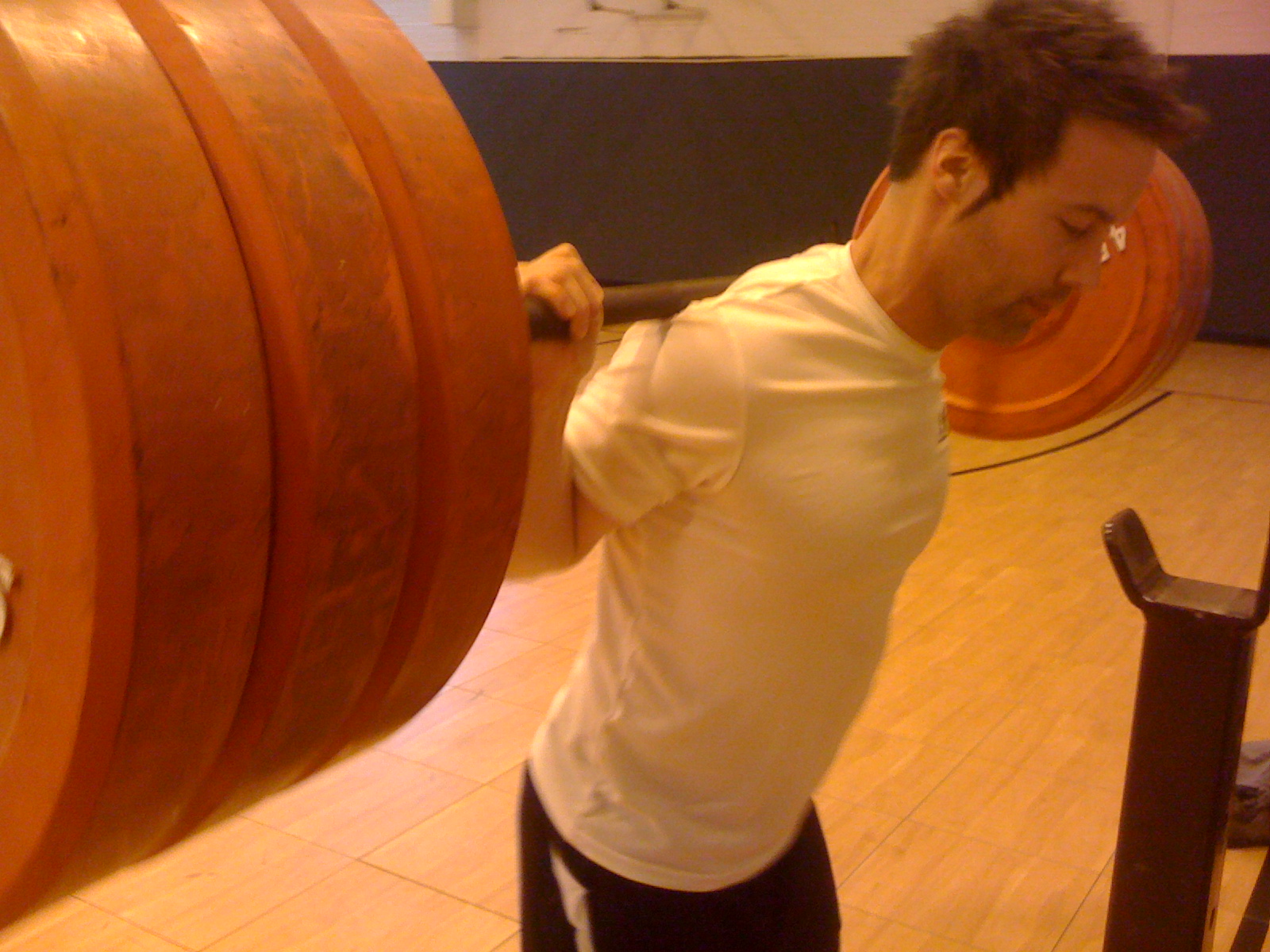
I felt a little sluggish for the first two weeks and CrossFit metcons really kicked my butt. It seemed like I had to work twice as hard only to come up a few seconds, sometimes a few minutes, short of a PR. However, my energy levels returned between the second and third week of low-car paleo eating. At this point I felt no energy slump in the afternoon (a problem I had previously) and I was having much less of a problem matching my PRs on CF metcons. Most important were the noticeable increases in strength and loss of body fat around the abdomen. Aside from the low-carb dealio and the exercise, it is very likely that the fish oil supplementation and the medium chain triglycerides from the coconut products were responsible for improving insulin sensitivity, which led to a loss of body fat and an increase in muscle mass. Six weeks into the experiment, I started setting new PRs on weighted metcons that had bested me many times before. My strength gains were phenomenal. At the time if the Eastern Canadian Qualifiers on May 2nd and 3rd of 2009, I weighed 168.5 pounds and had a 405 lbs back squat, a 430 lbs deadlift, a 185 lbs press, and a 300 lbs front squat. After 8 weeks of eating a low-carb paleo diet and following the main site WODs, I weighed 175 pounds and looked leaner (I could see all my abs). Most important was the fact that I now had a back squat of 415 lbs, a deadlift of 465 lbs, a shoulder press of 200 lbs, and a front squat of 330 lbs. (Note From Robb here: Mat suffered a moderate-severe flexion injury of the lumbar spine which he rehabbed during this time. There was a period of months in which 135lbs on the BS was quite uncomfortable for him, so these improvements need to be viewed not only through the lens of absolute improvements, but also the fact he recovered from an injury) My strength was increasing by doing only CrossFit WODs on what was essentially a borderline ketogenic diet! I should note that I did not suffer from Steatorrhea at any point during the experiment.
So where to go from here? I’m going to keep this up because I know I’ll be healthier in the long run by consuming fewer carbohydrates. Does this mean that post workout carbohydrates are bad? Absolutely not! In a situation like the CrossFit games, with multiple workouts throughout the day, PWO carbs are essential. Replenishing glycogen stores takes approximately a day on a low carb diet whereas wolfing down some mashed sweet potatoes will get the job done in a few hours. In addition, the fact that fat slows down gastric emptying probably means you don’t want to be eating a whole lot of it during competition. Easily digestible protein and carbohydrates are still the way to go in a games setting. However, I think my experiment highlights the fact that PWO carbs are a powerful tool that should be used sparingly under the right conditions. Avoiding a carb load after a workout will allow you to hold on to the insulin sensitivity you gained from exercising. This is a huge boon, especially for clients who are trying to improve their body composition. Whether you are a CrossFit, weightlifting, endurance, or any other type of athlete, I don’t see why a high carb diet should be considered “necessary” to fuel your endeavors.


Quick question about PWO meals, since I train multiple times a day – CFE in the morning then Strength at night followed by 10 min rest then a WOD – should I not be eating a PWO meal after the strength and WOD? Should I cut out the antioxidents? Since my stores should return to normal by the following morning…I currently have a PWO meal after both routines exactly 15 min after, since that little magic window only exists for a short time, and it’s usually composed of water, scoop of whey(30g protein), honey(9g worth of carbs) and some matcha powder (anti oxident). Eating paleo with all carbs coming from vegetables instead of fruit (body comp improving from that alot).
Thanks for the great post!
How much ozs of meat are your eating per meal? Also I have read having just a small sweet potatoe in the morning with eggs is a good start to provide energy throughout the day “some” Paleo diets. What’s your thoughts on that? Also completely cutting out carbs did you feel as though you were losing strength ? Email me and let me know your opinions . I don’t do crossfit but I train heavy with Olympic lifts and power lifting for about an hour and a half per workout.
Check out the Troubleshooting Guide you can get from this link https://robbwolf.com/resources/ specifically the power athlete section.
Great stuff. It was a pleasure to meet both of you in Boston.
Mat,
Awesome review of your experience with low-carb paleo. This is very interesting to me, because I had been toying with this idea myself, but I was concerned about not having any energy.
I noticed you do your WOD consistently at 3:00PM, which offers you a 24 hour recovery time. My WOD time varies day to day, and sometimes I only have 10-12 hours between a WOD, like if I workout in the evening one day and then in the morning on the following day. Would you think I should eat additional carbs in this case to replenish glycogen stores, or not? I guess I could always experiment with it and see how that goes.
I’m looking forward to your future comments and articles. Thanks also for all the great links, especially on the food.
Nice post! One question. Why, why, why would you buy and consume light coconut milk vs. full fat?
The only question I have is concerned with the PWO meal. The article states “Avoiding a carb load after a workout will allow you to hold on to the insulin sensitivity you gained from exercising”
What is defined as a “carb load”. The amount of carbs ? Carbs w/out protien to balance ?
Great post! My experience with low-carb paleo so far has been very similar.
One question though, any reason he’s choosing the light coconut milk over regular coconut milk? I’m curious because I use regular coconut milk, since I don’t really count fat blocks anymore. Wondering if I should be using the light coconut milk too.
I use Trader Joe’s light coconut milk because it is pure, with nothing added like sulfites or carageenan, and the cans at TJoes aren’t lined with BPE. Good stuff– now I never miss milk in my tea and my special late night ritual is a glog of coconut milk in a cup with boiling water poured over it.
Norm,
If you are currently following a paleo diet with lots of veggies and maybe some fruit then you don’t need to worry about antioxidants. Try to stick with only protein post strength work and WOD and see how you do.
Edward,
I don’t have much experience with less than a 24 hour recovery window. Tinker with just protein PWO and let me know how it goes. You could also go for some protein + coconut water. That stuff is greta for recovery and has a little bit (less than 2 blocks) of carbohydrate.
Ward,
Light coconut milk is easier to drink. I like to poke a hole in the can and down the whole thing in one sitting.
Kevin,
Great question! Most of the studies I’ve seen use a significant amount of carbohydrate, sometimes up to 1g per kg of body weight. If a 16-block athlete consumes half her allotted carb blocks/day in the PWO window, that is 8 blocks (72 grams) of carbohydrate. Waaayyyy too much. Like I said, great for competition settings but not necessary on a daily basis. I lighter carb intake would likely have less of an impact on insulin sensitivity but I don’t have any data on that right now.
Just a test comment,
Great Article Matt. You totally need part 2 to this rather large ‘can of whoop ass’ you just dropped on us.
I think you agree with the idea
that WAM isn’t very Caveman?
Also, is ‘Stat’ dangerous.
Any tips for constipated clients starting paleo?
Mat,
What did you do to your back? Was it disk related? How did you rehab it?
I hurt my back (butt tucked under in the bottom of a back squat and something happened) in March and immediately went on a long break. Sciatica got out of control and the MRI showed a herniated disk. I’m not sure if it’s all disk or partly due to the big chunks of scar tissue in my lower back muscles from repeated injuries. Nerve adhesion? Man I wish I would have seen all that info in the journal before I put my back in such stupid positions all those times. Kelly Starret told me to keep moving (squats and deadlifts are OK) and keep the weight light. Seems to be working.
What kind of exercises helped you the most in your recovery?
I just signed up with Chestnut Hills CSA. I’m looking forward getting the first shipment. Hopefully I can make it in for the November rotation. Thanks for the recommendation Mathieu!
Great write-up!! I recently increased my carbs to more zonish proportions but I think I’ve been convinced to go back to straight low carb paleo for body comp and recovery.
I think I fell for a little Barry Sears low-carb fear mongering after re-reading Mastering the Zone.
Bill-
Barry is always trying to set what he is doing apart from the other approaches. he actually attributes ketosis to protein intake in most of his works, and appears oblivious to the therapeutic potential of a ketogenic diet.
Apparently he does not realize his own Athletes Zone diet (17%P 23%C 60%F) is…a ketogenic diet.
Anybody try this diet while engaged in a program of long distance running?
No idea on the long distance running gig.
Rob, (in regards to long distance running)
Timothy A. Olson just broke the course record on the Western States 100 utilizing carb restriction, but not nutritional ketosis.
Ben Greenfield just won a triathlon using carb restriction along with surgical use of “super starch” on race day which does not prevent fat oxidation or ketone production.
I myself had done a half marathon trail run after 12 weeks on a zero carb, meat only, high fat diet in nutritional ketosis. It was a truly life changing experience to feel the energy come and come. I took no food during the run at all, only water and maybe a handful of beautiful blueberries found on the trail 🙂
refer to runketo.com and the facebook group https://www.facebook.com/groups/RunKeto/ lots of guys there running ultras in keto
I think it’s going to be tough to do anything glycogen demanding on keto. Real tough. Crossfit, MMA, etc is going to be a bear.
Mat,
Thanks for the post. What was your diet like before starting low carb-paleo?
Interesting article. That’s very impressive improvement in strength but not enough data on other aspects of performance IMO. What long term changes did you have on workouts lasting between 90 seconds and 45 minutes?
I thought if you didnt eat some carbs PWO after about 45 minutes Your body would essentially become insulin resistant? That was the one of the main reason a PWO meal was so great (that and the rapid absorbtion of amino acids into the muscles) but your saying that if you dont eat a PWO you will maintain your insulin sensitivity? Am I totally off track?
Mat,
What’s your verdict on coffee? I’m averaging 4 shots of espresso daily, an admitted, full-blown addiction. Nut butters are a big part of my intake also but I didn’t see any on your sample menu. Thanks for the article regardless. Very inspiring and will be passed on to my clients.
Wow Mat, fantastic post. You’ve got a goldmine of links in there and you’ve inspired me to tighten up my paleo efforts (which are currently driven to a very large degree by the ultrayumminess and convenience of fruit).
The Bitter Truth video was great. It wasn’t until about halfway through that I realised that the presenter was the same guy I read in an interview transcript from 2007 – here it is btw: http://www.abc.net.au/rn/healthreport/stories/2007/1969924.htm Lustig is great; a very engaging presenter.
Hey there! Great post so far. However, I think you can learn more about weight loss and getting optimum low body fat by visiting this website! http://www.threesixtyhealth.com
It includes fitness tips, and teaches you getting in shape. Weight loss should not be done using extreme diets or related things like that! Getting in shape should be much easier. Find a fitness buddy and guide each other the path down low body fat today!
Do visit http://www.threesixtyhealth.com
Cheers,
Kelsey.
Kelsy-
Are you fucking KIDIDNG me brother? If you are going to pimp your crap, at the very least make it something besides machine based circuits and shit nutritional recommendations. Why don’t you try to figure out how to help some people instead of peddling crap?
Hi Rob,
How are machine based circuits shit? I lost 40lbs doing just that – and it worked excellent for me. Additionally, a ton of MMA fighters do that exact same thing.
The goal of this site is to help people , and I feel bad you cant see that.
Very best,
Kelsey.
I am not sure its correct to say “A tonne of MMA fighters do the same thing”. At best they spend maybe 5% of their total training volume doing “machine based circuits” Even Rich Franklin who’s youtube video is what started the idea in MMA only did that type of training a few times a week, compared to his total training volume that was a drop in the bucket.
A lot of MMA fighters also do daily roadwork, and this is something paleo universally puts down. But there is a VERY long history of daily roadwork in all combat sports. And there is a very good reason many fighters with their heavy training schedule make time to squeeze it in, daily.
@Kelsey
LOL…I thought that post was sarcastic at first but then I realized you were serious. Don’t waste your breath or rather finger typing on posting links to useless sites on a site(robbwolf.com) that, IMHO, is changing people’s lives and actually getting people results.
@Mat Lalonde
Thanks for posting your results.
@Robb
Just pointed 2 students in my course this last week towards your blog. One was a Celiac and the other a Type 1.
To both Robb and Mat-
Say someone would want to zone the diet Mat is doing. I can figure out the carbs part of no more than 50 grams a day, but what about the protein and fat part. I currently in take 20 blocks of pro, 10 carb, and 90 fat a day. For my PWO meal, I 5-7 block my carbs and heavy protein, but I am starting to tinker with protein powder and coconut milk and no carbs for PWO. Thanks for any input. Love your blog!!
Mat,
It was great meeting you and Bobbi in Albany, NY yesterday. Thank you for your time and sharing your passion.
Sean,
Good question. I typically really don’t care much for Zone Block Calculations but I’m on the bus back to Boston with nothing better to do. I’m a medium male, which would put me at approximately 17 blocks. The carbohydrate calculation is the trickiest because I think the zone counts fiber as carbohydrate where the ‘useable carbohydrate’ does not take fiber into account. 5 to 6 blocks of carbohydrate is good if fiber is not taken into account in the block system (5 blocks x 9 grams of carb/block= 45 grams of carb. Since, 17-5=12, I need to replace 12 carb blocks with 3×12 fat blocks (I’m assuming you’ve read Robb’s ’42 Ways to Skin the Zone’ article). So I need to add an extra 36 fat blocks to my prescription. I can see my abs so I use the athlete’s zone on 5 times fat. So that gives me a total of (5×16)+(3×12)=116 blocks of fat. Given that I’m using gluconeogenesis for glycogen replenishment, my protein intake probably needs to be higher than 17 blocks. I think anything between 18 and 20 blocks of protein would be good. The final tally would be something like 18–20 blocks protein, 5 blocks carbohydrate from vegetables, 116 blocks fat. I know the fat seems really high but keep in mind that it is the source of energy driving the process of gluconeogenesis.
I’m really excited about this article. It’s the kick I needed to move to a heavily modified zone of roughly 5 blocks of carbs a day (sounds terrifying – I’m an 18 block male).
Quick question on the fishoil. Robb I know you recommend the Kirkland product. But Mat, I see you prefer taking the liquid straight. Any thoughts/explanations on the preference. Specifically to Robb: do you take the Kirkland capsules that have about 300mgs of EPA/DHA or the ones that have 68X mgs of EPA/DHA? I ask only because the 300mg capsules are technically cheaper if you calculate milligrams of EPA/DHA per penny. Of course, taking those would also mean pounding about 30 capsules a day. Just wondering…
Starting tomorrow – low carb/paleo – looking forward to the fitness…
Alex-
I just like them because they are cheap and easy for me. I slug down a hand-full with each meal. Between 6-9 caps and it’s easy.
Mat (and Robb):
Thanks for the detailed food log and the links. I’ve experimented last few WODs with not taking in any food right afterward; the DeVany link was especially persuasive.
So, a few days ago I cut down about half my carb blocks to 5-6 per day and replaced with add’l fat blocks (up from 10 to about 25). Protein is the same at 10 blocks. I’m making a point to use coconut oil and unsweetened shredded coconut. I cut out the grains.
I have noticed improvements in recovery and I feel like I am just sailing through the metcons. Is this some kind of happy pill?
Also, as to the coconut specifically – when I eat a little coconut a couple hours before the WOD I find I don’t feel the need to immediately refuel after the WOD like I used to, and I don’t feel as cooked.
I do eat some quality dairy. Another future experiment might be removing the dairy but I am not going to immediately introduce another variable. So far without grains, so good. Unlike months ago I have had no ill effects or adjustment period cutting out the grains and lowering the carbs overall. I think the difference this time is where the fat is coming from and the amount of it (more coconut and fish oil; no nuts).
I’m curious too about long distance running with this low-carb approach and will check back….
Thanks again for all the great info guys!
Sarah-
The distance running SHOULD be fine with this. The lower the relative intensity, the more we naturally rely on fat as a fuel source.
Hi Tyler,
As a previously constipated person I thought I’d add my 2 cents worth.
Taking our grains and dairy will make a difference. Dairy is a major contributor to constipation, especially children. Grains mess up your gut. Even wheat bran, leads to more bulky stool only but doesn’t feel great.
What works for me:
Lots of raw especially dark green leafy salads, like spinach or mixed greens (not lettuce – it’s not as effective). 3- 4 cups day at least, has minimal carbs so no issue here.
Ground flaxseed, 2 – 3 tablespoons a day – I have it with breakfast.
Kiwifruit, 1 – 2 per day proven to work in studies.
Take a course of probiotics, and use other probiotic foods like saurkraut.
Take lots of fish oil.
Robb,
Thanks for getting back to me. I go the Kirkland brand because you have said that it’s legit when it comes to purity. But do you recommend one Kirkland over the other?
180 Softgels – 648 mgs of EPA/DHA – roughly 75mgs of EPA/DHA per penny
OR
400 Capsules – 300 mgs EPA/DHA – roughly 123 mgs EPA/DHA per penny
I’m very concerned about purity, and was wondering if you “endorse” one over the other.
Also, as a side note, refrigerating my fish oil completely fixed the “fishy burp” problem. So thank you for that easy fix.
I am 5’9″, 160, 8-10%BF with similar lifting numbers. I’d like to get to 175, same BF, increased lifting numbers, maintain lower weight met con times. I read the mass gain article Robb wrote for Perf. Menu. This is a completely different approach, but you got the results I want!!! Your approach is more logical, low carb, not a gallon of milk a day etc..
Tyler T,
I think any type of diarrhea is dangerous over time. Aside from the obvious effect of dehydration, nutrient stores can be severely depleted and electrolyte balance can be affected if the condition persists for days. If it ever happens, I recommend a little bit of coconut water to hydrate and load up on lost electrolytes.
Robb might be more insightful on the whole constipation dealio. I’ve never had any problems of that sort.
Marshall,
I tried to cut a 1RM back squat short and ended up tweaking my sacroiliac joint. Nowadays, if I can’t do a full squat (way below parallel) with the weight, I don’t lift it.
I did a lot of bodyweight workouts and gymnastics during recovery. Stretching was really important. I have tight hips and glutes and that may have set me up for injury in the first place. I replaced heavy back squats with light overhead squats. Robb recommended some sled work and that was also really good. Once the back healed a little bit, I started incorporating a lot of light kettlebell work. I was then able to move back to light squats and deadlifts. My injury was almost completely healed when I started this experiment.
Mark,
Did you sign up with Chestnut Farms or Chestnut Hill Farms? Either way, I’m sure the meat will be excellent. Enjoy!
Robb,
Like Robb said, slow long distance relies heavily on fat for fuel. Being fat adapted should be advantageous for endurance athletes.
Mat,
I was eating fruit at every meal and I would religiously eat 2 cups of mashed sweet potatoes with cinnamon and 2 hard-boiled eggs after every workout.
Russ Greene
I can’t perform oly lifts in the school gym so I don’t have any data there. My numbers in 20 minute AMRAPs and any workout below 20 minutes improved. My numbers for longer workouts stayed the same. As Robb will tell you, I’m mostly built of type II muscle. Endurance is my weakness.
Rob Mcbee,
Robb and I are the yin and Yang of coffee. Robb loves it and approves of its consumption in large quantities. In fact, he often admits to being unsuccessful at committing suicide with caffeine.
I recommend no more than one cup per day. Coffee does trigger a ‘Fight or Flight” response from the body and may very well allow one to burn out faster. If you;re tired during the day, take a nap. It has been shown that a 20 minute nap can pack in some high quality sleep cycles.
I was wondering if decaf coffee triggers that ‘Fight or Flight” response? Are there other stimulating ingredients in coffee in addition to caffein?
Decaf is much less.
Alex Darr,
The capsules often contain fish oil of lower purity. In addition, the manufacturers will often add glycerin or other crap in the capsules. I just don;t want to deal with it so I go with the liquid.
Miss Spinach,
Coconut is truly awesome food. The medium chain triglycerides it contains has been shown to improve insulin sensitivity and cholesterol profiles. In addition, the amino acid content of coconut protein is interesting in that it contains some arginine (15% of the protein in coconut meal). Arginine is important for the synthesis of nitrogen monoxide, a chemical messenger in the body that is responsible for vasodilation and increased blood flow.
Mat,
Just to comment on:
“The carbohydrate calculation is the trickiest because I think the zone counts fiber as carbohydrate where the ‘useable carbohydrate’ does not take fiber into account.”
Sears does use useable carbs in his block amounts, he takes fibre off, (Specifically taught in his Zone certification course). However not all his blocks are 100% accurate when it comes to vegetables .
In our country (New Zealand) the nutrition labels are different. For example labels have total usable carbs and list the fibre separately. Makes it easier to figure out blocks or carb amounts.
I put a link to my “zone skinning” spreadsheet if anyone wants a copy. It makes it easy to play around with your carb/fat blocks per the “42 ways” article. I have the macronutrients broken into blocks/grams and percentages. You just put in your RX’d blocks, fat multiplier, and how many blocks of carb you want to remove and it calculates the new blocks (triples the fat for reduced carb blocks and adds it to whatever your base fat is). Excel spreadsheet.
Bill!! You kick asss! I’m putting that spread sheet in the FAQ if you don;t mind?
Thanks Mat. I’m on light back squats and deadlifts myself. I’ll try the overhead squats instead. I think the increased stabilization is what has helped me get the sciatica under control. Plus overheads are freaking hard and there is less risk of overloading my spine.
Robb,
A while back there was some debate about what to eat after workouts and sweet potatoes and applesauce and all that stuff came up. Then after that you mentioned an article that convinced you to switch to thai coconut milk and whey protein post workout. Are you still on the thai coconut protein shake and did you find that it worked well for you? Or have you gone to no food post workout? And what about the 30 min window and all these Barry Sears vids?
Marshall-
This might be the topic of my first podcast as folks are obviously troubled by PWO eating the just the various eating options in general. It all comes down to your situation, goals and how you respond to food and training. Low carb shakes are NOT the best option for people who are really trying to lean out, solid food is…and a little time after training before eating is even better. But that is not the appropriate course fo action for an MMA competitor who is doing multiple sessions per day! Everyone wants a cook-book but folks need to THINK!
Please do. I’m glad to contribute after freeloading off your site for so long!!
Mat,
Great post. I am trying to gain some serious strength and have been told to drink (lots) of raw milk. I’m guessing this would elicit a huge insulin response, but maybe it could fit in your low-carb paleo world??
Thoughts? Many Thanks, Chris
Matt,
that is some great info there. I have a question for you though.
I just went back to carbs PWO about two months ago (mashed sweet potatoes and applesauce), half my days blocks of carbs (I delete the rest). I had my bf% taken today and found that it had gone up from 6.5 to 8.5. I am looking to lean up just a bit. I am on 17 blocks, 4x fat with half carbs deleted right now. I was going to drop down to 3x fat.
Do you think I should up my fat to 5x though and cut the carbs PWO per an earlier post I saw? Is it necessary to take all 5 blocks of carbs (via vegetables ) PWO or can it be spread throughout the days meals.
thanks for all the info and keep up the good work guys….
Chris,
I have never tried the paleo+dairy approach but it seems that a lot of peeps on the CrossFit Football program are doing fine with it. The approach does come with a risk of insulin resistance. I think Robb had a problem with increased insulin resistance during his mass gain experiment where he was consuming goat milk post WOD.
I’d recommend giving a low-carb paleo approach a try for a couple of months to see where that takes you.
Ian,
I’d recommend sticking with the 17 blocks, 4xfat while using only veggies as your carb source. Don’t count the carb blocks if you do this, it really doesn’t matter if you stomach 5,6,7, or 8 blocks of carbs from veggies during the day. If you absolutely want a little bit of carbohydrate after a WOD, I recommend an individual serving of coconut water. Clocks in at just under 2 blocks of carbohydrate and has plenty of electrolytes.
Cool, thanks for the reply Mat. I’ll do that, maybe bump up the protein to 20 blocks some days. I think I’ll just stick with the low carb post workout for now. I got alot of good ideas food wise from that article too. I bought some unsweetened coconut. Delicious! Also got some of those chocolate nibbs…..thanks again. I’ll keep everyone posted on how it goes.
Mat &/or Robb,
Following up on my little experiment eating fewer blocks of protein and a ton of fat blocks (about 6P, 4C, 30 to 45F). This isn’t much more than base zone calories….
That ol’ time of the month approaching, and perhaps my dietary tinkering, has sent me into a full-scale cheese craving. So far, my performance in workouts has not suffered, but I’m a little tired at other times of the day. Granted, my dairy sources are all raw, grass fed, and the cows were probably also meditating while they were being milked…but yeah, I’m not a football player and don’t wish to look like one. I’m already pretty lean and want to stay that way 🙂
I don’t know if it is my body wanting the usual 10 blocks of protein again, or some difference in how my body responds to the insulin effects of dairy as my progesterone levels drop with my cycle.
I’m going to back away slowly from the cheese plate, eat as much protein and coconut as I feel I need, and see if that helps…
My situation just might dictate a very different eating pattern week to week, not necessarily workout to workout.
Things are still light years ahead of where I was just weeks ago, so I’m just fine-tuning here. All this good fat and I’m not the cranky bitch I used to be. Yay!
Sarah-
I really do not see a point to eating under the 10 blocks of protein. In general i’d have you eat well in excess of that.
Mat
Great article, very good read. How do you feel about adding milk products in with this diet and how much of an effect do you think it would have?
Gabriel,
Read my reply to chris a few posts above.
Yeah, I’m back up to 10 blocks of protein and eating more meat as opposed to the raw dairy. It is a lot of food to shovel in but I shouldn’t complain about that!
Hey Matt,
I recently did a consult with Rob who recommended your post on low-carb.
I noticed you said that it took two weeks for the leanness to start happening. How lean where you to begin with and how lean did you get to during your low-carb approach. How many weeks did it take to get there. Also when you drank the coconut milk did you drink the whole can in one meal or did you spread it out. The Francois Pralus is that considered carbs or fat never heard of such chocolate. The navitas are they also carbs or fats How much did you consume for both items. Trying to follow your guidelines
and lean out at the same time.
Thank you,
Carlos Madero
CMAD
Carlos,
I was above 10% body fat when I started and now I am below 10%. I measured body fat before and after the experiment, which took 2 months to complete. I leaned out gradually as I conducted the experiment but I did not take any measurements until the end.
I do in fact drink a whole can of coconut milk in one sitting but it is the light stuff. The regular stuff is hard to drink but easy to eat with a spoon. I don’t think I could consume an entire can of regular coconut milk in one sitting.
100% chocolate, whether it is cacao nibs or from the French producer François Pralus, is mostly fat and it is loaded with antioxidants. I did not weigh or measure anything. I just whatever foods I wanted from the given choices while limiting my carbohydrate intake to vegetables.
Hey Robb,
I went to your nutrition seminar a year ago and found it very helpful. My problem for a few months is weight loss. I do CF 4 x a week and run 3-4 times as well ( 2-5 mile runs).
I am so frustrated with a lack of weight loss. We went through a very stressful family event back in May and I put on 8 pounds over night it seemed. Now, I can’t loss it no matter what. I’m on 10 blocks, switched to Paleo challenge 30 days ago and gained a pound! I’m getting enough sleep most nights, the big stress is over, but my body won’t let go of this new muffin top. The only think I can figure is I’m still eating too much nuts. I don’t know what else to do. I’m very frustrated.
Any thoughts, comments, suggestions?
Christina-
Cut the nuts back, and back the frack away from the scale!!! Take some photos and waist measurements. Then pick a CF benchmark like helen and beat your PR (do you have full pull ups yet?). I do no care what your WEIGHT is, I care about how you Look, Feel and Perform. I think you are doing too damn much work, CF then at most 2 running day, both intervals with full recovery. One-2 of those CF days had better be strength only or 90% strength followed by a small met-con. If you have gained weight due to stress beating the dog piss out of yourself will NOT help things.
Mat / Robb,
I know Mat already said that he didn’t WAM, but then he answered a question about the math and in it he assumed 17 blocks to start with. Is 17 blocks really enough for the kind of strength / muscle gains that he got or do you think he might have been consuming more?
A few months ago I started working with an O-lifting coach on strength building and a month ago he was surprised I hadn’t put on more muscle. As we talked about nutrition he suggested I increase my protein to 2g / 1kg body weight (that puts me up to about 23 protein blocks). I increased my protein and over the next two weeks put on 4 pounds of muscle. Unfortunately, I also put on 4 pounds of fat. I was hoping the increased muscle mass would lead to lower BF%. I’m not sure whether to stick with this longer to give my body more time to adjust or start tinkering / making adjustments now. Any suggestions?
In this same time I have cut my carbs back and increased my fat blocks to compensate based on reading this post from Mat. I also cut out almost all fruit in favor of veggies. Since I haven’t been doing AMRAPs and such during my strength-building focus, I wasn’t eating sweet potatoes for a while (used to eat them PWO). But, I’m running into the same problem I’ve had before whenever I try to be very strict with my food quality. My energy is high, my skin is clear, but my stomach gets gassy and upset and I end up quite the opposite of the person who asked about constipation. Adding sweet potato back in helps a bit. Crossing the paleo line to add some oatmeal and such helps a lot. Once things are settled again, sweet potato tends to be enough starch to maintain stomach happiness. I’m curious if any of your clients or any other readers have encountered this.
Also, with the decreased amount of veggies in Mat’s Low Carbing, any concern about not getting enough vitamins and minerals from food?
As always, I really appreciate all the help and information! Thank you both very much!
will!
There are like 8 questions in there brother! More soluble fiber (yams) certainly can help with digestion. If you look at the amount of veggies in Mat’s plan, it still a load of vet/min and far more than most people eat on any program.
Thanks for the verbal slap in the face. I did have 1 day of allowed whinning! Yes, I’ll back off the nuts, run only 2 days a week, and I love my heavy days. Those have suffered lately. I’m back on track. THANK YOU master teacher!! I will see results!! On to the 2nd ,30 day palleo challenge!! Bless you…
Quick question for either of you guys (Rob or Mat),
I noticed Mat didn’t eat for awhile after his workouts. I work out fasted (usually 14 hours) and was wondering if I could get away with the same. My clinicals are 12 hour days and if I work out at 5am and eat right after I’ll either be done eating around 1 or 2 for the day or I’ll be starving all day if I spread the food out….
Ian-
You just need to tinker. do you look feel and perform the same, better or worse? that is what drives all this stuff.
Mat,
RE: Nordic Naturals Fish oil.
Just to clarify:
You do mean 3 TABLESPOONS per day right, or 12,375 mg of EPA/DHA, 405 kcals per serving, 45 grams fat?
Thanks for the article!
Bill,
That is correct. If you are a Zoner, you should not count those 40 grams of fat.
You don’t count the fish oil fat? I did not know that…..Thanks for catching me up to speed.
Quick question. When you 5x fat on the athletes zone, do you multiple the original zone blocks before adding fat blocks that replace carbs? Or multiple all the total fat blocks, including carb block replacers?
Thanks!
Buck!
Give the FAQ a read and see if that clarifies the issue. If not, ping me again.
Bill,
I didn’t catch the mistake the first time but three tablespoons of Nordic Naturals Fish Oil is 12.375 grams (or 12.4 g) of fat, not 40.
Mat- can you give us and update? Still progressing? Bumper plates yet?
Thanks for the article. I’m in my 4th week of following this; all positives so far. Not crashing in the afternoon has been a welcome change.
Robb and Mat,
in your opinions what would you say is more important for fat loss and maintainance: insulin sensitivity or calories in vs. calories out?
Ian-
we can starve someone, keep their insulin relatively high and simply peel muscle mass off the person. Conversely, we can limit insulin, barely limit calories, and remover fat and not muscle. Best scenario, adequate protein, low carb, calorie restricted plan.
Not to beat a dead horse (fish), but doesn’t 1 TABLEspoon = 3 TEAspoons?
Here are the supplement facts for the Nordic Naturals fish oil. I’ll save a lot of money if it turns out to be 1 tablespoon per day, and I should still be getting plenty of DHA/EPA…I think. Thanks in advance Mat!
Bill,
Yes, 1 Tablespoon=3 teaspoons
Ian,
calories in – calories out makes no sense in the absence of endocrinology. You can put someone who is insulin resistant on a starvation diet and they will mostly lose muscle mass because their fat stores are not accessible. On the ohter hand, if you are dealing with someone who has good insulin sensitivity and has cortisol under control, a slight caloric deficiency is all it takes for fat loss. Of course, the whole process works best on a low-carb plan.
Chris,
I read plenty of times that the paleo diet maximizes testosterone and growth hormone output but I had never seen the effects until I went low-carb. Muscle mass is just increasingly easy to put on and maintain. I have been following OPTs WODs since I wrote this post so I don’t have any benchmarks to compare. Nevertheless, my appearance, mood, and performance couldn’t be any better.
Bill,
I was under the impression you thought 3 tablespoons of Nordic naturals fish oil was 40g of EPA+DHA. My bad. 3 tablespoons is 12.375 g of EPA+DHA and a total of 45 grams of fat. If you are a zoner, this fat does not get deducted from your daily fat blocks because you are making up for an absent nutrient.
Mat-
If you did the OPT comp wod’s this past wknd, how’d you do, and what was your meal plan? And, on days with multiple wod’s per day have you been deviating from your “no-post-wod-meals” plan? I’ve been following the OPT wods for some time now, and I played around with the pwo shake (whey, and OPT Refuel) on a couple of the double days and it seemed to mess me up a bit; upset stomach and screwy appetite. Curious if you’ve played with this?
Mat,
Does a “cheat” day 1x per week blow up the effects we are looking for on this program?
Thanks, CB
Chris,
A cheat day once per week will not have a huge effect on your fat burning capacity. Adding a cheat day will take the plan closer to a cyclic low-carb approach, which is totally legit.
Chris Dunkin,
I don’t think I did the OPT WOD on the weekend you are referring to. I switched to a Wendler 5/3/1 + CF type deal. I do strength twice a week using Wendler’s approach but combining shoulder press + deadlift and bench press + squat on the same day. I then do 2 met cons to complete my training. I try to cater to both strengths and weaknesses in the process.
I totally loved doing OPTs program but I just didn’t have the time to hit the gym more than once per day so I really couldn’t follow the program as prescribed and I felt like I couldn’t reap all the benefits as a result.
Hey Mat,
so you work out 4 days/week? Also did you ever throw in a high carb pw meal like once/week or something, or did you just keep it LC the whole time?
Are you still rolling LC too?
Also Mat, how do you best control cortisol as you mentioned in response to my question on Nov. 17?
this is about to get long here, but I ask because I was down to 6% bf in the summer, then I dabbled with IF. It was a disaster and my bf shot up 2.5-3% (mostly in my abdomen) in two months. No change in diet except I threw in some sweet potatoes pw. everything else was low carb. LOTS of longer metcons, 4 or 5 days/week. I was doing workouts fasted and then not eating for an hour or two afterwards. I suspect this had ALOT to do with the elevated cortisol. Now I’ve gotten smarter with my training, doing 4 day/week MEBB (3 days strength w/ short metcon after and one day of 12-15 minute metcon) and I already feel better on my third week. I usually always get 8 hours sleep, and now trying to get it closer to 9. I’ve been taking vitamin C alot as I read this helps with cortisol issues. My insulin sensitivity is pretty good IMO. I recently dropped calories to 2000/day, carbs under 50, protein @ 180g and fat @ 120g. I just dont know if lower cals will mess with cortisol or not……I know this has been long, but I appreciate any insight.
thanks
Ian
Ian,
I stuck with the low-carb plan the whole time and did not use high-carb PWO meals.
Prolonged intense physical activity, caffeine, sleep deprivation, stress, and anxiety will increase cortisol secretion. As such, eliminating those long met cons was a good idea. Once a significant amount of work capacity has been developed, one could argue that even 20 minute AMRAPs are too long. Your current Mebb training looks pretty solid and so does the sleep schedule. If you are having a hard time leaning out with that program, I would try eliminating the post workout meal. It is not necessary if you only workout once or less per day. Keep in mind that food deprivation is a stress on the body and that your caloric intake needs to be adequate for your level of exercise. If you cut calories too low, your performance will suffer and your fat loss may be blunted. There are studies that show that some people can store body fat on severely calorie restricted diets if the diet is mostly composed of carbohydrate. Then, there is the possibility of losing muscle mass if you cut your calories too much and your body is not fat adapted. Caloric restriction and intermittent fasting are a stress on the body and can backfire if not used properly.
That Trader Joe’s Light Coconut Milk mentioned here is the worst tasting coconut milk I have ever tried. Clearly reducing the fat and calories reduces the flavor …
Thai Kitchen’s Lite is ok, I find.
Mathieu, great presentation in Montreal by the way (you prob don’t remember but my girlfriend and I were at odds with our nutrition prof? we wanted to take on the canada food guide…)
Quick question, if this eventually comes your way: should I be at all concerned with oxalate inhibition of mineral absorption of brassica veggies, like kale and broccoli, etc? can’t remember where I read it, but I read somewhere that oxalates in these veggies impaired Ca++ absorption…
thanks,
Roelant
I feel that while eating the Paleo way may work for shorter intensity workouts and weight loss. I find it nearly impossible to keep a heavy 1-2 hour a day triathlon training schedule if following the paleo diet. I also feel that in the long run, feeding oneself on a main diet on fats and proteins cannot be healthy.
I understand that the Paleo diet is predicated on our ancestors hunter/ gatherer diet, but we as humans have evolved, and have eaten grains and starches for thousands of years.
Love Cross-Fit, just not how the Paleo diet is pushed so hard.
From my understanding, Nell Stephenson (see http://www.nellstephenson.com) and her husband are both triathletes and Paleo-devotees…just an FYI.
On the issue of fruit- If one is not concerned with leaning out, or very low carb nutrition;
According to one blog Mat says to limit fructose intake on a daily basis, but what does this really mean- A handful of berries? Less? Same with nuts, while someone like Mark Sisson seems to advocate a more liberal approach to nuts and fruit. I’m coming from a health perspective, not neccesarily a performance one.
Robb…might you know why coconut (in all forms) makes me feel hungrier?
Thank you!
wow! Matt’s hardly taking in any calories..
Very nice article, Mat and Robb! It’s a luck that I was able to find it. But I have such a question. Paleo diet is mainly meat-oriented. Can I combine meat with eggs for example and get similar results? And what about fruits, aren’t they high in fructose, which is promoting fat gains?
Thanks for the article.
Thanks for the auspicious writeup. It in reality used to be a entertainment account it. Glance advanced to far delivered agreeable from you! By the way, how could we be in contact?
Mat,
I started on the same type of diet recently and I am dying in my WOD’s. I am about 1 month into the diet and still am slower than usual in my WOD’s but my strength is still pretty good. As a result of feeling tired, I was thinking that I was not getting enough carbs since I was around 50g to 100g per day. I was thinking of upping my carb intake to fill my glycogen stores for working out. After reading your article, I will stick it out for another month or two to see how things improve. How are you doing now? It’s been over two years (around October 9, 2009) since you did this experiment.
Thanks,
Mark
NO, I’d put the carbs back in! Immediately.
Robb,
What’s up with the latest comment you put in about adding the carbs in immediately? I know Mat posted all this back in 2009, so I didn’t know if you had recent updates.
Seems like the best time to add carbs! Talk about this constantly in the podcast.
Check out podcast episode 68. Mat gave an update to his low carb while crossfitting experiment.
Mat or Rob,
Just wondering how you (Mat) feel about the low carb thing and CrossFit now in 2014? I have done low carb, paleo for 3 weeks solid with about 40g of carbs or less a day and had NO power! I mean I felt I had a monkey on my back through all my crossfit workouts. I wondered if this will pass and will I get this surge of energy at some point or do you have any other suggestions? I’ve been Paleo for about 3 years, but not this low of a carb diet. I’m 50, premenopausal and have a stubborn 15lbs to loose!!!
Jaqueline!
I need to post an update to this. I (we) do NOT endorse a LC plan with Crossfit. This was some experimenting that IMO hits a brick wall very quickly. I’d read the following:
http://robbwolf.com/2012/02/06/paleo-diet-am-i-losing-enough-weight/
http://robbwolf.com/2013/01/09/thoughts-carb-paleo-episode-3-hope/
I know this is an old post, but I want to venture into keto. I am a 43 year old female and I crossfit 4 times a week. I am 5’5″ and weigh 157, and am probably around 26-27% body fat. I can’t seem to shed the fat. I would love to weigh in the 130-140 range, but more importantly, I want to be at or below 20% body fat. Can you possibly tell me what my macros and calories should be? I’ve researched ALL kinds of stuff, but everything makes so much sense OR makes no sense at all. It’s easy to weed out the crap, but there’s so much stuff out there that says this is great and other stuff says no way! I want to experiment with it, but wanted to see if you would be able to point me in the right direction.